 |
| Aluminum Parts |
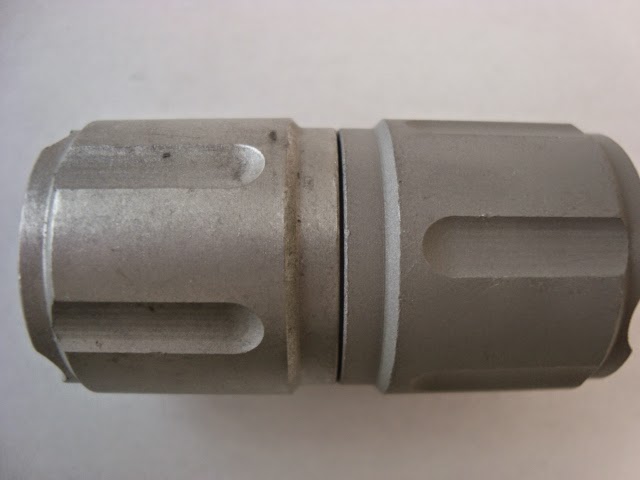 |
| Glass Bead (left) vs Aluminum Oxide Grit (right) |
The Glass Bead blasted part has much more a peened, smooth, uniform finish. The Aluminum Oxide Grit blasted part also has a uniform finish but is more etched and 'darker'.



   The Finished Part Blog
Showing posts with label aluminum oxide. Show all posts
Showing posts with label aluminum oxide. Show all posts
Wednesday, December 17, 2014Glass Bead vs Aluminum Oxide Grit
The Glass Bead blasted part has much more a peened, smooth, uniform finish. The Aluminum Oxide Grit blasted part also has a uniform finish but is more etched and 'darker'. 
Thursday, May 2, 2013Tumble Blasting Paint Hooks
Continuously painting parts using an automated process often involves hanging the parts from a moving track using paint hooks. These hooks invariably will get a build-up of paint and need to be stripped. Abrasive blasting with the proper media will strip the paint and allow the maximum usage lifetime of the hooks. Using a tumble blaster will allow for automated blasting of many parts in a batch and minimal downtime for the hooks.
The two pictures below show the part both before blasting (painted black) and the hooks after blasting with either 60 Mesh Aluminum Oxide Grit or 12-16 Mesh Melamine Plastic Abrasive Blast Media. A batch of these parts were tumble blasted for only 6 minutes at 60 psi.
Upon a closer analysis, the Melamine actually provided an overall better result as can be more clearly seen in the comparison picture below. The Melamine Plastic part on the left does have a small amount of paint left on the surface but enough exposed metal to allow for the hook to perform properly and even could be used in a electro-coating process, if necessary. The Aluminum Oxide blasted part is also clean but this media tended to etch the metal and will ultimately result in fewer usable cycles and/or failure of the hook. 
Thursday, October 11, 2012Glass Bead vs Aluminum Oxide for Deburring Steel Machining and work-hardening steel creates burrs and scale that needs to be removed. The part in the middle of the picture above shows the 'excess' material in threads as well as the darkening caused by scale formation in the heat treating process. While barrel or vibratory tumbling can be used to remove these burrs and create a smooth surface finish, threaded areas often need to maintain the square edges and dimensionality on the part. The other two parts were blasted with different types of abrasive blast media to show how each media can accomplish the deburring task but create a totally different surface finish. The part on the left was blasted with a Medium Glass Bead (70-100 mesh) and resulted in a satin-like surface finish with clean edges. The part on the right was blasted with 120 Mesh Aluminum Oxide Grit and has a more matte, gray surface finish. While Glass Bead can often result in a more aesthetically pleasing finish, the micro-profile achieved with Aluminum Oxide Grit is often required for future processing of the parts (i.e., coatings application).
Tuesday, March 27, 2012Powder Coat Stripping
Powder coating is used in applications where a tougher finish is required than a traditional liquid paint. The free-flowing, dry powder is typically applied electrostatically and then heat cured to form the bond. Powder coatings are very difficult to remove from the sub-surface as they are often thicker and more aggressively bonded to the surface than more traditional coatings.
Removing powder coating from a surface can be a challenging process. In addition to the thickness of the coating, the bond between the powder and the metal often requires more energy to break than the force needed to etch or potentially damage the sub-surface.  This powder coated punched hole wire mesh was stripped (right side) using an abrasive blasting process with 60 mesh Aluminum Oxide Grit. A larger grit size was also tested (which did strip the coating more quickly) but the metal surface became too heavily etched. Less aggressive media such as Glass Bead and Plastic Abrasive Media were unable to efficiently remove the coating.
Friday, October 28, 2011Heavy Slag on Steel When laser cut (or saw cut), steel parts can develop heavy slag on the edges (see picture above). The slag is developed as the metal is melted during the laser cutting action and then re-forms on the edges on the 'bottom' of the part. The excess metal can be removed by hand grinding; however, if the parts are small or there are many parts to be cleaned, hand finishing is not efficient.  The finished part above was barrel tumbled part-on-part to remove the slag and excess metal on the edges. A small addition of 36 Mesh Aluminum Oxide Grit increased the abrasiveness of the tumbling action allowing the process to go from the before to the after in only 30 minutes. While the surface finish is rough after the tumbling process, the parts can be painted or sent through additional steps using other tumbling media to smooth out the finish and possibly polish the part.
Wednesday, October 12, 2011Increasing Tumbling Abrasiveness
There are a number of strategies that can be used to increase the abrasiveness of both barrel and vibratory tumbling operations. These can be used when a boost to more aggressive surface finishing. deburring or edge rounding is needed.
Identifying the critical issues with your part will determine which strategy(ies) are best to employ. Of course, all these strategies work just as well in reverse to decrease the abrasiveness.
Wednesday, September 14, 2011Glass Bead vs Aluminum Oxide for Cleaning Aluminum Parts
Monday, April 11, 2011Etching Stainless SteelStainless steel can be polished to mirror surface finishes. Sometimes, the surface needs to be etched in order accept a coating or prepare the part for a process that requires a little 'grab'. While tumbling in a vibratory system or a barrel tumbler will create a matte finish, the surface is generally not rough enough for many coatings. Also, when the parts are small, it can be difficult to separate the media from the parts in a tumbler.  Stainless Steel Etching When an etch is required and the parts are small, a tumble blasting process is often an ideal solution. The stainless steel parts above (before and after) are less than 1/2" in any dimension. These parts were tumble blasted with 60 mesh Aluminum Oxide Grit for only 20 minutes. Depending on the size of the blasting basket, batch sizes as large as 3 cubic feet can be processed at one time.
Wednesday, January 5, 2011Powder Coat Removal
Summarized from the ShopTalk Forum:
Question: I race ATV's and each winter tear them down for rebuilding. What would be the best blast media to use to remove the old powder coat? I don't want to etch the frame too much as some of the parts are aluminum. I am trying to use a material that can be re-used so it's cost effective. A media that is not too dusty would be preferred since I am blasting indoors. I will be powder coating over the frames so what grit would leave a proper profile? Response: Powder coating can be difficult to remove so a relatively aggressive media is needed. A 60 Mesh Aluminum Oxide Grit should strip the coating and leave the aluminum metal with a light etch for re-coating. Aluminum Oxide can be re-used up to 30 times.
Wednesday, December 22, 2010Scratch Resistant Coatings
Improving the life of a coating such as polyurethane, acrylic or epoxy can be achieved with the addition of a small amount of a abrasive such as Aluminum Oxide, White Aluminum Oxide or Silicon Carbide. These materials are significantly harder than the coating material and will increase the scratch resistance of the coating with minimal impact on the other properties of whatever coating you are using.
The specific type of abrasive will depend on a variety of job specific requirements including color, clarity and thickness. The size of the abrasive used is generally a very fine grade such as a 600 or 800 mesh but larger grit (~240 mesh) can be used in thicker coating. The addition rate is also very dependent on the coating you are using specifically related the solids content. Rates of 3 - 5% (about 1/2 pound per gallon) are common.
Monday, September 27, 2010Rock Tumbling
Rock tumbling and stone polishing is a popular hobby. The most important ingredient to achieving a great finish is time. Polishing is typically a 4-step process involving progressively finer and finer abrasives. Each step is done with a clean barrel, fresh water and a virgin abrasive. The Creetown Gem Rock Museum (in the UK) has a good outline for polishing stones.
The first three steps require a coarse grit (80 mesh) followed by a medium abrasive (220 mesh) and finally a fine grit (400 mesh). Aluminum Oxide or Silicon Carbide are the preferred media due to their durability and hardness. The fourth step demands a very fine, hard media that will maintain it's 'cutting' ability for the entire cycle time. Cerium or tin oxide are the abrasives of choice as they will maintain their sharp edges as they break down over time. Sawdust can be added to this step to ease the impact and eliminate chipping of the stones. Hobby size barrel tumblers will generally have capacities of just a few pounds of stones. Tumbling times for each step is about 1 week. Larger, industrial-grade tumblers such as the MT Series Barrel Tumblers will allow for more weight to be tumbled at one time. This often leads to reduced cycle times and higher production rates. Regardless of the equipment, patience is the key to beautifully polished rocks and stones.
Thursday, July 8, 2010Wood Deflashing Before This saw-cut wood part (before) has sharp edges and flashing that need to be removed prior to staining and sealing the wood. The traditional process would involve hand sanding with progressively finer sand paper. Given the round shape of the part and the requirement to sand the interior areas, a sanding wheel process is not feasible.  After This finished part (after) has been barrel tumbled for 8 hours with Hardwood Media and Aluminum Oxide Grit. Since the part has some 'closed', internal areas that need to be sanded, the Hardwood Media is ideal to get into those areas and provide a much larger surface area for surface finishing. The grit acts as the sanding medium to quickly and efficiently removes sharp edges and result in a smooth surface. If a very smooth surface is required, a couple of steps with finer and finer Grit will perform similarly to hand sanding with finer grades of sandpaper - without the hand work required.
Thursday, March 11, 2010Titanium Stents
Finishing medical parts requires very stringent testing and results to ensure that the parts are deburred properly. Titanium stents are inserted into arteries to keep them open. A properly deburred edge and smooth surface finish is absolutely necessary to ensure that the medical part works exactly as expected.
Titanium is a hard metal and is often deburred in a vibratory tumbler with Ceramic Media. The size and shape will depend on the geometry of the part and size of the openings. Adding a medium size grit such as Aluminum Oxide will increase the abrasiveness of the tumbling process and provide a smooth, rounded edge. If embedding of the grit is of concern, using a Ceramic Media that is aluminum oxide free (i.e., KDF Bond) with an addition of Silicon Carbide will also produce excellent results.
Wednesday, February 10, 2010Abrasive Blast RoomsAbrasive blast rooms offer a lot of advantages when blasting large parts and when using a re-usable media such as Aluminum Oxide or Steel Shot. These rooms provide an area that can collect the media, send it to a recycling and separating system and then be re-blasted. Blast rooms can also be equipped with exhaust and dust collection systems. The major drawback is the cost typically in excess of $100,000.  An alternative to a blast room is to perform the abrasive blasting in either an outdoor area that is 'closed' in or to blast in a separate room such as a garage or shipping container. These areas can be set up to contain the media and dust but will limit the media choices to consumable, less expensive blasting media such as Crushed Glass Grit. In order to use a re-usable media, a system such as the Blast Room Package is needed to collect, separate, clean and blast the media. Simply sweeping the used media, dust, dirt, paint chips, etc. into a feed hopper will transfer the recycled material to the abrasive separator, clean out large pieces, remove the dust and send the good media to the pressure pot for re-blasting. The Blast Room Package can simulate nearly all the benefits of a full-fledged blast room but at a fraction of the cost.
Tuesday, August 11, 2009Etching Steel Question: I am looking at using media blasting to identify/mark items made from stainless steel sheet using stencils to allow shielding of areas I don't want to blast. The stainless steel (used in a food factory) is highly polished. I was hoping media blasting would give a different enough surface finish to make the marking easily visible but what media would be best to achieve this? Also, would a direct pressure or suction system media blasting cabinet be best? The factory air system produces up to 90 psi and supplied more than enough air to run lots of machinery. Response: You can use either Aluminum Oxide or Glass Bead to create the marking you described. Aluminum Oxide will produce an etched finish with finer grit sizes producing a smoother, lighter etch. Glass Bead will produce a smooth, peened finish with finer grades producing a more uniform, matte finish while coarser grades will leave a brighter finish. Either a suction system or direct pressure blast system could be used. The pressure system will typically shorten the cycle time, produce a more uniform surface finish and allow for more media re-use since you can blast at lower pressures.
Thursday, June 4, 2009Blasting Stone with Sand
Question: I am thinking of purchasing a small business doing stone engraving. My only concern is blasting with the silica sand which is what is being used right now. We plan to use a blasting room and filtered breathing system but I don't know how safe I can be using silica sand. I am curious about alternatives like silicon carbide and aluminum oxide and could use any tips and advice on how I can do this kind of work safely.
Response: Blasting with silica sand is definitely NOT recommended - even with a breathing apparatus. Both Aluminum Oxide and Silicon Carbide are more aggressive blasting media than sand and will provide quicker results and a better surface finish on stone. Both of these media can be used with standard abrasive blasting systems without modification. Of course, always minimize breathing any kind of dust when blasting.
Tuesday, May 26, 2009Stone Engraving
Question: I am thinking of purchasing a small business doing stone engraving. My only concern is blasting with the silica sand which is what is being used right now. We plan to use a blasting room and filtered breathing system but I don't know how safe I can be using silica sand. I am curious about alternatives like silicon carbide and aluminum oxide and could use any tips and advice on how I can do this kind of work safely.
Response: Blasting with silica sand is definitely NOT recommended - even with a breathing apparatus. Both Aluminum Oxide and Silicon Carbide are more aggressive blasting media than sand and will provide quicker results and a better surface finish on stone. Both of these media media can be used with standard abrasive blasting systems without modification. Of course, always minimize breathing any kind of dust when blasting.
Thursday, May 14, 2009Non-Skid Flooring Non-skid or anti-slip flooring is generally created by embedding an abrasive grit into a floor coating. The most versatile and durable grit is aluminum oxide since it is available in a wide variety of grit sizes and does not break down in high traffic areas. Broadcasting the grit onto a tacky floor coating (e.g., epoxy primer) followed by a top coat will 'lock' the grit in place. These pictures show examples of using 36 grit white aluminum oxide on the left and 24 grit white aluminum oxide on the right. Notice the difference in media density used and the height of the 'peaks'. Given a fixed coating thickness, larger grit will provide more non-skid properties and a rougher surface. White aluminum oxide is used to minimize concerns about discoloration of the coating system.
Friday, February 6, 2009Compressed Gas Cylinder Cleaning
Question: I'm interested in ceramic and glass sphere media for tumbling compressed gas cylinders to remove rust and organic contaminants. I want to clean these cylinders for oxygen service. My cylinders range from large (5' tall by 10" diameter) to medium (2' X 7") in steel to small (1' x 4") in aluminum. I'm primarily interested in doing a thorough job cleaning the cylinders without damaging them.
Response: The following recommendations would be appropriate:
Monday, February 2, 2009Abrasive Blasting Media - Steel
This final installment of the Abrasive Blasting Media series will discuss the merits of using both Steel Shot and Steel Grit for blasting. Both of these media types are produced from scrap steel which is melted, modified and then solidified into a generally round shape (Shot) or angular particles (Grit).
Steel Shot produces a very smooth finish on the surface of metals. The rounded shape does not strip a surface very effectively but rather peens the surface to produce a clean, smooth and (sometimes) polished finish. The smaller the shot the better the polish but the less aggressive the peening operation. The peening action of the shot is also used to impart compressive strength or hardening to metals. Steel Grit is used when aggressive stripping action is required. Steel is softer than Aluminum Oxide so will not fracture as easily but the higher density produces a forceful blasting process. Smaller sizes and softer formulations of grit are used when lighter cutting is required while larger sizes and harder steel formulations will maintain the particle angularity and a high strip rate. Since both Steel Shot and Steel Grit have a high bulk density of about 250 pounds per cubic foot, special or modified equipment is necessary to blast these media using air pressure alone. Steel is often used in wheel blast operations where the media is propelled by a wheel using controlled force.
Subscribe to:
Posts (Atom)
Subscribe To
 Posts
All Comments
Posts
All Comments
|
|||||||||||
| |||||||||||
|
©
Kramer Industries, Inc. All rights reserved. | |||||||||||
|
| |||||||||||
























