

Mass Finishing Equipment at Kramer Industries Inc Home Home Home ShopTalk Blog Search Help Cart Contact
Sign In Order History
Right From The Start - Call us at 1-888-515-9443
The Finished Part Blog

The Finished Part Blog

Showing posts with label vibratory tumbler. Show all posts

Tuesday, October 29, 2013

Heavy Deburring - Small Parts

Deburring Small Parts
Often times, the machining of small parts can lead to very heavy burrs and difficult areas to finish. The steel gear pictured above has a diameter of about 1/4". The machining to make the gear teeth left very heavy burrs on the edges (see part on left). The burrs can be seen as the excess material that is hanging off the edges and rolled into curls. All this steel needs to be removed before the part is functional.

The two primary criteria for finding the proper media are (1) small enough to get into the area between the teeth and not get stuck and (2) aggressive enough to remove the extraneous steel and burrs without overly changing the dimensions and tolerances of the part.

This part was deburred (see part on right) using a general purpose, deburring Ceramic Cone in a vibratory tumbler. This shape was chosen since the tip of the media will get between the teeth to remove the burrs. The general purpose bond or formulation (KM in this case) provided the best balance of deburring without being overly aggressive.

While this process did remove nearly all of the burrs on the gear teeth in only 1 hour, looking closely at the finished part will reveal some material still left on the edges. In some cases this metal needs to be removed as well and would require longer cycle times, more aggressive media and/or additional grinding steps.

Wednesday, December 5, 2012

Deburring Steel Parts

Machined steel parts often need to be deburred. For large quantities of parts, both barrel tumbling and vibratory tumbling can accomplish this task saving labor hours and increasing throughput capacity. The specific details of the process must be chosen carefully to ensure that the parts are not only properly deburred but that the other surface finish specifications are met as well.


The machined part on the left in this picture has a bright surface and sharp edges. The goal was to deburr the edges with minimal impact on the surface finish. The initial result (part on right) of tumbling with Ceramic Media and a general purpose compound did deburr the part but it also resulted in a dull, matte surface finish.

This part will need to be tumbled in second step using a polishing media and a different compound to bring the desired finish back. Having a clear understanding of the ultimate surface finish required and that multiple steps are often needed is the first step in finding the best solution to finishing parts.

Friday, September 3, 2010

Deburring Aluminum Slots


Selection of media shape and size is critical when trying to deburr slots and holes. The material type (i.e., aluminum, steel, plastic) is also important in identifying the proper type of media. The part pictured above (machined on left; tumbled on right) required complete deburring of the part, decent edge rounding and a uniform surface finish. The customer's next step in the process was to create a dull, anodized finish.

The part contained a variety of geometric features including approximately 1/4" wide x 1/4" deep slots, both large a small holes, square interior corners and radiused edges. The finished part was vibratory tumbled with general purpose (KX bond) 1/4" x 1/4" Plastic Pyramids. This shape and size of media was selected in order to get into the corners of the slots and result in a uniform surface finish across the part including interior corners.

The general purpose media resulted in a dull surface finish ideal for creating a matte, anodized final surface. If a brighter anodized finish was specified, a secondary polishing step in a vibratory tumbler would be improve the results.

Friday, May 7, 2010

Cascading Vibratory Tumbler

The key to achieving the optimal result in a vibratory tumbler is to make sure that the vibe is properly filled. Processing parts in vibratory tumblers is most efficient when the media and parts are able to tumble in addition to vibrate. In a tub-style vibe, this cascading action happens from one side of the tub to the other.

The video below demonstrates how a low media level simply vibrates the load and any tumbling that does occur is from the middle out to the sides. As media is added, it is clear to see how the media load begins to tumble from the right to left.

Thursday, October 1, 2009

The Right Way to Vibe

Vibratory tumbling can be a successful method for deburring, polishing and surface finishing. When a vibe process is operating correctly, the load (blend of tumbling media and parts) will not only vibrate against each other but the entire load will tumble or cascade from the outer wall to the inner wall in a bowl and from one side wall to the other in a tub. This circulation provides maximum energy transfer to the load. If the vibe is not filled properly, the load will typically tumble from the middle toward the sides forming a high point in the middle of the load and lead to poor and inconsistent results.

The tumbling media transmits the vibration energy to parts. The interaction of the media and the parts achieves the desired finish. Typical media to part ratios (by volume) of 3 to 1 or higher will keep the parts separated in the load and minimize part-to-part interaction or impingement. Low media levels or a low ratio will not allow the media to properly 'carry' the parts in the process.

Tuesday, September 15, 2009

Parts Tumbling Checklist

As the economy seems to be improving and production is starting to show signs of life again, now is a good time to review your barrel or vibratory tumbling process to optimize efficiency. Here are a few issues to consider:
  • Perform maintenance on machine - check electrical system, grease bearings, clean bowl/tub and check lining
  • Check separating screen deck (if any) for cracks and secure to vibe
  • How old is tumbling media and how much has it worn down?
  • Make sure load is still tumbling properly and bowl or barrel is filled to appropriate level
  • Compare parts finish to previous batches to confirm results continue to be consistent
  • Review recirculating system and age of compound.
  • Confirm proper solution flow rate and clean nozzles and pumps.
Adding some or all of these checks as part of a periodic maintenance program will keep your process consistent, efficient and productive.

Tuesday, March 31, 2009

Media to Parts Ratio

The number of parts that can be tumbled (vibratory or barrel) will depend on the dimensions of the part and the desired final finish. Lower ratios of media to parts (no media, 1:1 or 2:1) will lead to rougher finishes and can be used on castings and forgings for aggressive deburring. Moderate and the most common ratios (3:1, 4:1 or 5:1) will minimize part to part interaction and are ideal for moderate deburring and surface finishing. High ratios (6:1, 7:1 and higher) are used for pre-plate and decorative finishes or for fragile parts

The quantity of parts that can be processed in a given system can be determined by first calculating the 'box' size of the part (basically width x length x height). Given the known volume of the tumbler being used (50% for barrels and 90% for vibes, typically) and the box volume of the part, the quantity of parts and media can be calculated for any ratio.

For example, let's assume a 3 cubic foot vibe and a part size of 2" x 3" x 4" (box = 24 cubic inches) and a media to parts ratio of 3 to 1. With the vibe 90% full, the total usable capacity is 2.7 ft3. At a ratio of 3:1, 25% or 0.675 ft3 (1,166 in3) of the usuable capacity will be parts. With the size part noted, the process will be able to tumble about 48 parts per batch (=1166/24). The balance of the capacity (2.025 ft3) will be tumbling media.

Friday, March 20, 2009

Vibratory Tumblers

Vibratory tumblers come in a wide range of sizes and shapes. The configuration of the vibe will determine the tumbling action of the media and parts. Bowl style tumblers will turn the load over and around the circumference of the bowl (3-D tumbling). A tub style tumbler will simply turn the load over (2-D tumbling) but offer the possible for tumbling long parts since there are no 'turns' in the vibe. Tub vibes are also generally more aggressive than bowls.

While most bowl style vibratory tumblers have a similar configuration (think: large doughnut), tub vibes come in a few styles. Some tubs are angular on the bottom with straight sides like a rectangle. This type of set-up is the most difficult to 'rotate' the load and can be very aggressive on the parts. Tubs that are more cylindrical in shape turn the load over very quickly. This can sometimes lead to longer cycle times but is better for sensitive or fragile parts. Vibratory tubs with rounded corners at the bottoms offer an excellent balance of tumbling action and aggressiveness. The systems offered by C & M Topline (the DB series) are an excellent example of this type of vibratory tumbler.

Wednesday, February 11, 2009

Deflashing Composite Wood

This customer molds a variety of glass filled plastic and wood composite items. The process creates significant flash on the edges that needs to be removed. The current process involves hand sanding that is time consuming, labor intensive and does not result in an even finish across the entire surface area of the part.

Since these parts cannot get wet (due to swelling and potential damage) the parts were vibratory tumbled with a fast cutting (KSF) Ceramic Angle Cut Cylinder Media with no water and no compound. The cycle time required to get a smooth, slightly rounded edge with a uniform surface finish across the entire part was only 30 minutes.

Monday, January 26, 2009

Stainless Steel Deburring and Polishing

Question: I modify stainless steel flatware and dinner service pieces for other uses. In the process of modifying I use heat to bend, cutting wheels, grinding wheels, drilling and some sawing. The pieces are blued from the heat and have grinding marks, cutting marks and holes with burrs. I am presently de-burring and removing grinding and cutting marks by hand. After cleaning up the pieces I polish them to a high shine by hand. I have recently obtained a vibrating tumbler. What suggested media can be used to do the clean up and the polishing? How long would it take to tumble in these processes?

Response: The surface roughness of your parts will determine what media to use. Typically the first step would use a preformed ceramic aggressive cut media (the larger the better) for material removal. The second step would be a general purpose ceramic. Both operations should be done with a nonferrous deburring liquid compound diluted to a proper user strength. The operation should be wet with minimal water or suds. Cycle time are typically 1-4 hours for these deburring steps.

For a bright finish a precision ceramic polishing or steel media can be used. A compound with good lubricity is recommended for this third step. Processing time may be 4 hours with steel media and up to 8 hrs with precision ceramic. For a higher polish and smoother finish, the parts can be tumbled in a pretreated walnut shell grit for 8 to 24 hours for a jewelry quality finish.

Monday, September 29, 2008

Screen Separating Basics

There are a couple of ways to separate parts from media. Basically, a screen is used to separate out smaller items from larger items. The best separation is achieved when the media and parts (or whatever is being separated) are different enough in size and shape to make separation simple.

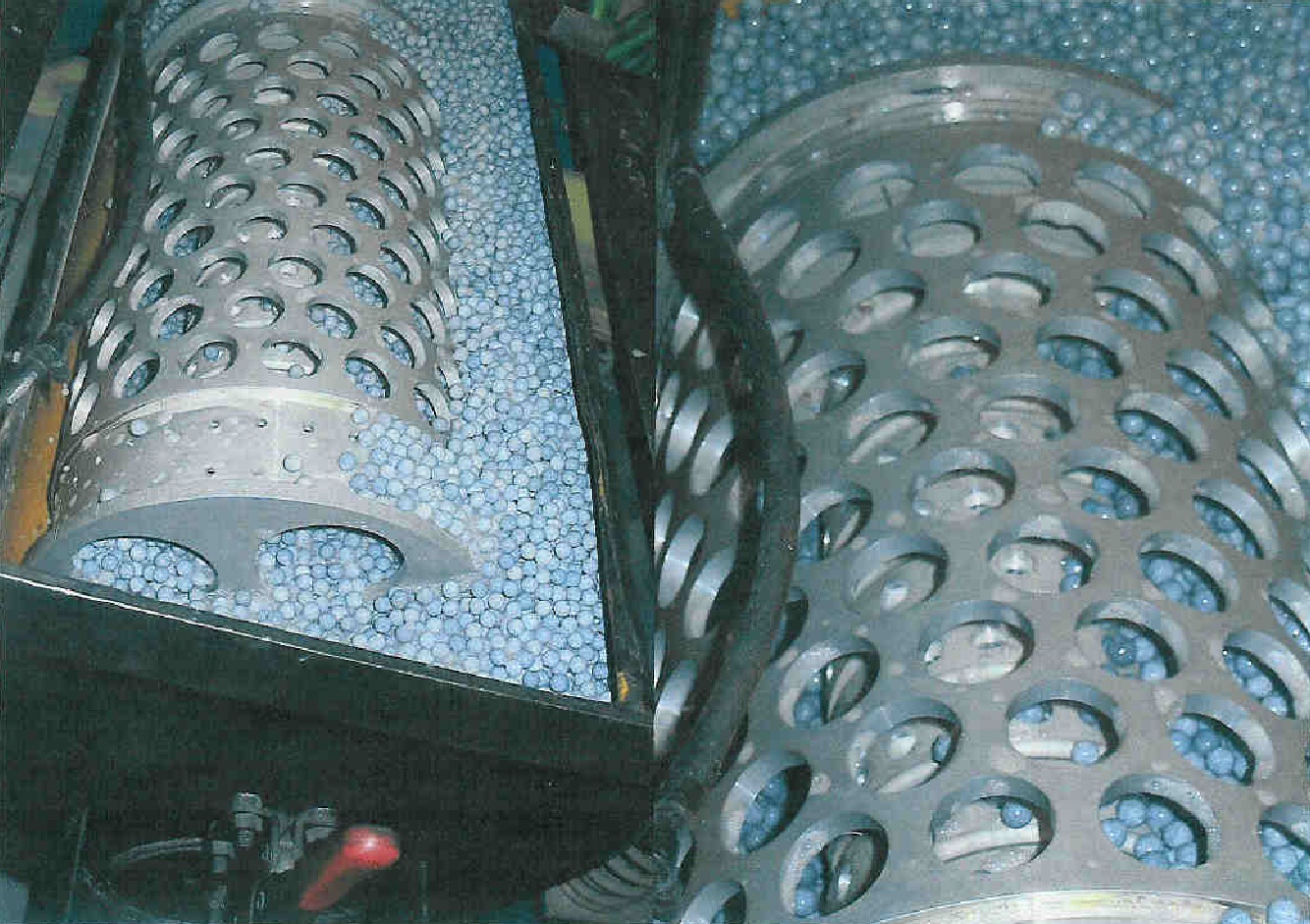
A tubular rotary screen separator will tumble the items to be separated while the load passes through the screen tube and the smaller items are separated. This type of process can be used for separating almost anything and works great for parts that 'hold' the media and need to be over-turned to be emptied. A tubular rotary screen separator can also process high volume loads (hundreds of pounds per minute if necessary). Multiple tubes in sequence can be used for multiple separations.

A flat vibrating screen is a good general purpose method to separate parts and media. Loads are simply emptied onto the vibrating screen and the smaller pieces fall through the screen. This is more of a batch process and ideal for small load sizes. A flat vibrating screen can be incorporated into vibratory tumbling systems for automated separation of media and parts in process.

The biggest challenge with screen separating is identifying a screen opening (size and shape) that will quickly and efficiently separate the load. If parts and media (or whatever is being separated) are very close in size and shape the optimal results will be much more difficult to achieve.

Monday, March 3, 2008

Mass Finishing Basics (Part 3)

Vibratory tumblers come in all different shapes and sizes. Bowl style vibes include both round bowl and oval-bowl shapes. Tub style systems look kind of like bathtubs. In general, vibes are produced in sizes as small as 1-2 gallons up to 150 gallons (and much larger). Both systems force the tumbling media and parts to vibrate and rotate around the vibe.

Tub style vibes force the parts (and media) to vibrate and rotate around the center axis of the tub. This creates a similar sliding and rolling action to a barrel tumbler but adds the additional vibratory energy working against the parts resulting in shorter cycle times. Since tub style vibes can be very long in length and diameter extremely large large parts can be tumbled.

Bowl vibes add circular movement around the bowl in addition to the typical tumbling and vibrating. Since the entire load is moving around the bowl, this system allows the option for a separating screen (either above or below the load) to automatically remove the parts from the media. Unlike tub style systems, bowl vibes can only process parts smaller than the bowl channel width.

Monday, January 14, 2008

Deburring Aluminum Tube

A client asked us for a process that would remove the burrs from an aluminum part consisting of an assembled tube within a tube. The part was made by inserting one tube into another and then bonding the assembly together. The outer tube was 4 inches larger in diameter than the inner tube. Holes were then drilled through both tubes of the assembly. The holes could only be drilled after assembling the two tubes together due to the critical tolerances involved. There were a total of about one hundred holes in each part. The challenge was to remove the burrs from the inner as well as the outer surfaces of both tubes.

The problem was solved by attaching the part to the vibratory tub in a fixed position so that it would move along with the tub, but still be able to rotate on its axis. By clamping the part down and forcing it to vibrate with the tub, the amount of energy transmitted to the part was greatly increased.

A deburring, ball-shaped Precision Ceramic Media was used to minimize the chance of having media get stuck inside the part. The tub was slightly under-loaded with media to increase the flow rate through the holes and to aid in rotating the part. The compound flow rate was kept at eight gallons per hour. A mild acid cleaning compound (Kramco 1030) was used to speed up the cutting rate and maintain good color on the aluminum.

Due to the elevated cutting energy, the part was completely deburred with a 0.005 edge break in a cycle time of ten to fifteen minutes in a tub-type three cubic foot capacity vibratory machine. The inner tube was deburred thoroughly, exhibiting a 0.003 edge break. The parts were originally being deburred by hand, which took over three hours per part. The vibratory finishing system developed not only dramatically reduced the cost of finishing the parts, but also produced a more consistent part than when finished by hand.
 
  • Barrel Finishing Systems
  • Vibratory Finsihing Systems
  • Blasting Systems
  • Abrasive Media
  • Tumbling Media
  • Chemical Compounds
  • Parts Separating Systems
  • KramerThinksGreen
  • Finishing Guides
  • Applications
  • Newsworthy
  • Repairs and Services
  • Material Safety Data Sheets
  • Catalog
  • Ordering Information
  • Guarantee
  • Newsletter
  • About Kramer
  • Contact Us
  • We specialize in customizing systems, products and procedures. There are many options and custom systems available. If you don't see something on our web site, please contact us.

    1-888-515-9443

  • Secured by Rapid SSL. 128 bit SSL Security. $10,000 Warranty.